In this article
- What happened to BONK on July 6, 2026?
- Why calling it a “$4.4M attack” understates the failure
- Four controls failed at the same boundary
- The hidden gap: the documented multisig was not the security boundary
- The stolen BONK became active float, not new supply
- How much of BONK's crash was specific to the attack?
- Why exchange warnings became a second problem
- This was not the Bonk.fun wallet-drainer incident
- What would prove that BonkDAO is safer now?
- What BONK holders can and cannot verify
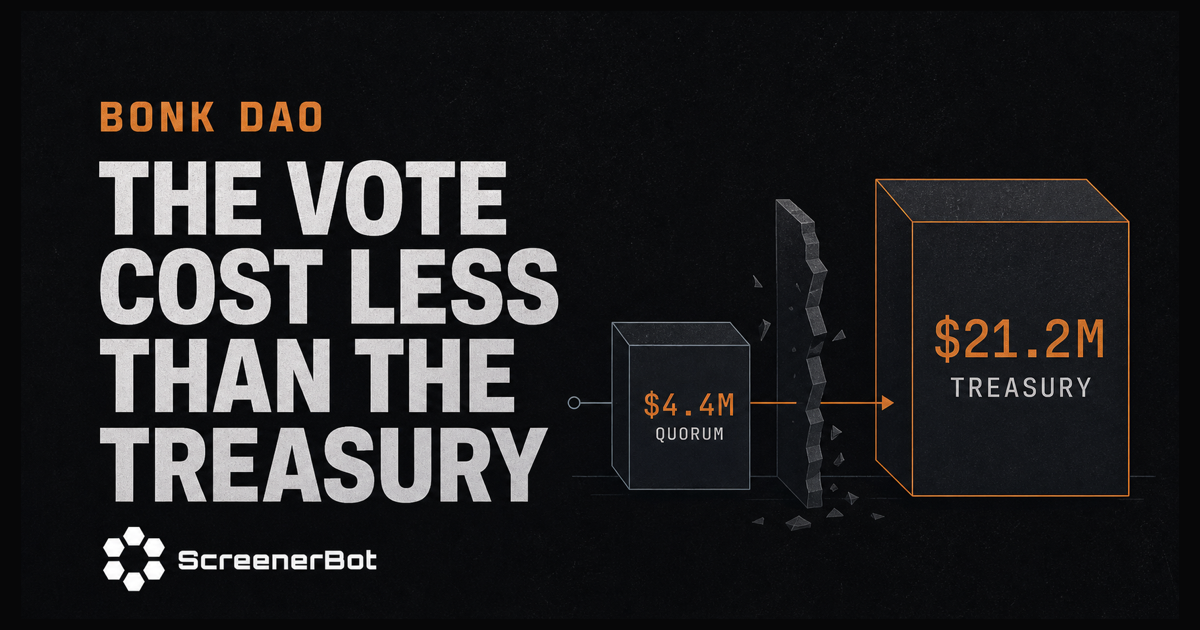
BONK did not suffer a token-contract hack. On July 6, 2026, one actor used BonkDAO's valid governance process to transfer 4,426,104,450,305 BONK, worth about $21.2 million, out of its treasury. The attacker bought enough voting power for roughly $4.4 million, cleared quorum by just 0.28%, and faced no execution delay or second approval.
The code worked. The security model did not.
| The short answer | What the evidence shows |
|---|---|
| What was compromised? | The BonkDAO treasury, through proposal BIP-76 |
| What was not compromised? | The BONK mint, holders' wallets, and the Solana network |
| Treasury moved | 4.426 trillion BONK, about 5.03% of circulating supply at the time |
| Voting position | About 882.3 billion BONK acquired for roughly $4.4M |
| Approval threshold | 879.95 billion BONK, or 1% of the configured voting supply |
| Execution delay | Zero seconds |
| Immediate market move | BONK was down about 9.0% from July 5 to July 7 |
| Wider aftermath | Down 53.8% by August 13, versus 22.6% for WIF and 7.5% for SOL |
This distinction matters. A clean mint authority or a safe wallet would not have prevented this event. It happened one layer above the token, where governance had permission to command the treasury.
What happened to BONK on July 6, 2026?
The operation began in public.
On June 30, a wallet created BIP #76 - “Sowellian BonkDAO” on Solana's Realms governance platform. The proposal's prose presented a plan to rebuild the DAO and reward yes voters. Its executable payload did something much simpler: transfer 4.426 trillion BONK from the treasury to 9bxW...JHvQ.
Over July 4 and 5, a second wallet accumulated about 882.3 billion BONK through Binance and Bybit and reportedly supplemented the position through DeFi borrowing. That was just enough to cross BonkDAO's 879.95 billion BONK approval threshold.
When voting closed at 09:42 UTC on July 6:
- 882,383,387,283 BONK voted yes;
- 710,848,288 BONK voted no;
- the dominant wallet controlled about 99.87% of the yes vote;
- only seven wallets voted; and
- the proposal executed immediately.
The exact proposal, addresses and transfer transaction remain linked from QuillAudits' incident analysis. The proposal itself is also still identifiable on Realms as BIP #76.
The quorum was cleared by 0.276%
The difference between the winning vote and the threshold was about 2.43 billion BONK:
Required yes votes: 879.95B BONK
Actual yes votes:   882.38B BONK
Margin:               2.43B BONK
Margin over quorum:      0.276%
That precision is important. This was not a whale casually voting a large existing bag. The position was sized to acquire the minimum control needed for one specific outcome.
Why calling it a “$4.4M attack” understates the failure
The common summary says the attacker “spent $4.4 million to steal $21.2 million.” That is directionally correct, but economically incomplete.
The $4.4 million was not a fee paid to the protocol, collateral that was slashed, or capital destroyed in the attack. It bought liquid BONK. CoinDesk reported that the attacker began selling that voting position just over an hour after the drain and offloaded roughly $5.3 million worth.
So the DAO did not force an attacker to sacrifice $4.4 million to access its treasury. It required the attacker to hold that amount briefly, accept market risk, and then sell it again. The recoverable voting capital controlled a treasury position about five times larger.
This is the deeper security error:
A 1% quorum can be adequate for a low-value opinion vote and catastrophically low for an instruction that empties a $21 million treasury. The permission and the value at risk must be priced together.
Four controls failed at the same boundary
BIP-76 needed a chain of permissive conditions. Removing any one of them could have broken the attack path.
| Control | BonkDAO configuration | Why it mattered |
|---|---|---|
| Proposal creation | 100 million BONK | A relatively small position could create an executable proposal |
| Approval threshold | 1% of voting supply | The threshold cost far less than the treasury it controlled |
| Instruction review | Transfer visible, but not mechanically escalated | No required review responded to a full-treasury movement |
| Hold-up time | 0 seconds | There was no intervention window after the vote passed |
| Secondary authorization | None on the direct transfer | No council or multisig had to approve the treasury instruction |
This was not a Realms code failure. Realms documentation makes the relevant governance parameters configurable. BonkDAO's program enforced its configuration exactly.
The failure was also not simply “low turnout.” Low participation made the takeover easier, but turnout is behavior, not a control. A treasury design must remain safe on the quietest voting day, not only when thousands of holders notice a malicious instruction in time.
The hidden gap: the documented multisig was not the security boundary
This is the part most incident summaries miss.
A March 2026 Osprey BONK Trust annual report described an apparently stronger operating flow. Approved treasury grants would be routed into an 8-of-11 council multisig, which would administer milestone payments to recipients.
That sounds as if eight council members stand between a proposal and treasury loss. BIP-76 proved otherwise. The live governance authority could encode a direct transfer from the treasury, bypassing the ordinary grant-administration path.
The filing's description was not necessarily false; it described how normal grants were intended to operate. But an operating process is not a security boundary when the underlying authority can route around it.
For treasury risk, the decisive questions are:
- What can the governance program execute directly?
- What is the largest value one proposal can move?
- Is a timelock mandatory for that instruction class?
- Does an independent signer or guardian have to approve it?
- What does it cost to acquire enough voting power temporarily?
If a review stops at “there is a multisig,” it can miss the account that actually owns the assets and the authority that can bypass the multisig.
The stolen BONK became active float, not new supply
The 4.426 trillion BONK was about 5.03% of the roughly 88 trillion circulating supply reported near the incident. It was also almost exactly the 4.43 trillion BONK that BonkDAO held at the end of Q1 2026, according to the Blockworks BONK holder report.
The attack did not mint 4.426 trillion new tokens. Those tokens already existed and were counted in supply. What changed was their market role:
- before the vote, one treasury held them for community initiatives;
- after the vote, an attacker controlled them;
- over the following 13 days, the balance moved toward centralized exchanges.
On July 20, Lookonchain reported that the final 400 billion BONK had reached Coinbase, completing the movement of all 4.426 trillion treasury tokens to exchanges. It estimated about $13.58 million in realized proceeds, down from the $21.2 million transfer-time value as the sale pushed into a falling market.
That is why “no inflation occurred” is technically true but economically insufficient. A dormant or strategically administered treasury balance became immediate sellable float. Markets price available supply, expected selling and governance credibility-not only the mint's total-supply counter.
How much of BONK's crash was specific to the attack?
BONK was already a high-beta memecoin in a weak market, so attributing its entire decline to one event would be wrong. The cleanest test is to compare the same dates against SOL and another major Solana memecoin.
We downloaded hourly USD market-chart data from the CoinGecko API for BONK, SOL and WIF on August 14, 2026 and used the observation nearest 00:00 UTC for each date. Returns below are measured from July 5, before execution.
| Date | BONK price | BONK return | SOL return | WIF return |
|---|---|---|---|---|
| July 5 | $0.000004841 | baseline | baseline | baseline |
| July 7 | $0.000004405 | -9.0% | +0.2% | -2.3% |
| July 13 | $0.000003961 | -18.2% | -5.9% | -14.9% |
| July 19 | $0.000002762 | -43.0% | -7.6% | -12.2% |
| August 7 | $0.000002788 | -42.4% | -11.1% | -20.2% |
| August 13 | $0.000002234 | -53.8% | -7.5% | -22.6% |
BONK's underperformance was therefore much larger than the broad SOL move and materially worse than WIF's. That does not prove a single cause, but it rejects the simpler claim that BONK merely followed the market.
The scale difference is revealing. BONK's market capitalization fell from about $426.0 million on July 5 to $196.6 million on August 13, a decline of roughly $229 million. That is more than ten times the transfer-time value of the stolen treasury.
Not every dollar of that decline belongs to BIP-76; SOL and WIF also fell. But the comparison shows why a treasury attack can destroy more market value than it extracts. Holders were repricing future ecosystem funding, governance safety, disclosure quality and a large forced seller at the same time.
Why exchange warnings became a second problem
The first exchange actions were not evidence that the BONK token contract had broken. They were attempts to limit the movement of disputed funds and reassess project risk.
On July 7, Bithumb designated BONK a trading-caution asset. Its stated reasons included an unresolved security incident that could materially affect value and inadequate timely disclosure through an appropriate electronic channel. Deposits were interrupted while the venue reviewed whether to extend, lift or escalate the warning.
That wording matters. The market problem had expanded from treasury security to incident communication. Even after the on-chain mechanism was understood, venues still needed credible answers about containment, governance changes and recovery.
Exchange notices are venue-specific and can change. A suspension of deposits or withdrawals is not automatically a delisting, and a warning at one Korean venue is not a global trading halt. Check the current notice from the venue itself before acting on screenshots or social posts.
This was not the Bonk.fun wallet-drainer incident
BONK, BonkDAO, BONKbot and Bonk.fun are related names, but they are not interchangeable systems.
In March 2026, attackers hijacked the Bonk.fun domain and displayed a malicious wallet-signing prompt. Cointelegraph's incident report says users who signed that fraudulent prompt were at risk; people who had merely connected before the breach or traded BONK elsewhere were not affected.
The July BIP-76 event was different:
| March 2026 | July 2026 |
|---|---|
| Bonk.fun domain/account compromise | BonkDAO governance takeover |
| Malicious front-end signing prompt | Valid on-chain proposal and vote |
| Risk to users who approved the prompt | Loss from the DAO treasury |
| Website and account security failure | Governance economics and authority failure |
Conflating the two leads to bad safety advice. Revoking a wallet approval addresses a malicious signing incident; it does not repair a DAO quorum or add a treasury timelock.
What would prove that BonkDAO is safer now?
A promise to “improve security” is not enough. The corrective evidence has to be executable and on-chain.
The strongest signs would be:
- a materially safer threshold tied to treasury value and liquid market depth;
- a mandatory 24-72 hour hold-up for treasury-moving instructions;
- transaction-class limits so one proposal cannot empty the treasury;
- an independent emergency cancel path with narrow, transparent authority;
- a secondary multisig approval for transfers above a defined value;
- automatic alerts that decode and highlight proposal instructions, not just titles;
- a published fund-flow and recovery accounting that reconciles every affected wallet; and
- a final post-mortem that distinguishes confirmed facts from attribution claims.
The first six controls should be visible in governance accounts, proposal code and treasury authority-not only in a blog post.
What BONK holders can and cannot verify
Holders can verify the proposal, vote totals, treasury transaction, destination addresses, exchange deposits and market response. They cannot infer who controlled every centralized-exchange account from public chain data, nor prove that an exchange deposit was sold simply because it arrived.
They should also separate token safety from governance safety. Our Solana token-security reference explains mint and freeze authority; those checks matter, but neither would flag a DAO treasury whose valid governance configuration can be bought cheaply. The ScreenerBot Token DNA surface helps investigate token and wallet evidence, while governance configuration still requires a direct review of the DAO's executable authorities.
As of August 14, the defensible conclusion is narrower than either panic or reassurance: BONK's token contract and holder wallets were not breached, but BonkDAO's treasury security failed exactly as configured; the stolen balance became active exchange-bound float; and the market priced the loss of trust far beyond the treasury's dollar value.
That is what happened to BONK-and why “the code worked” is not a defense.