In this article
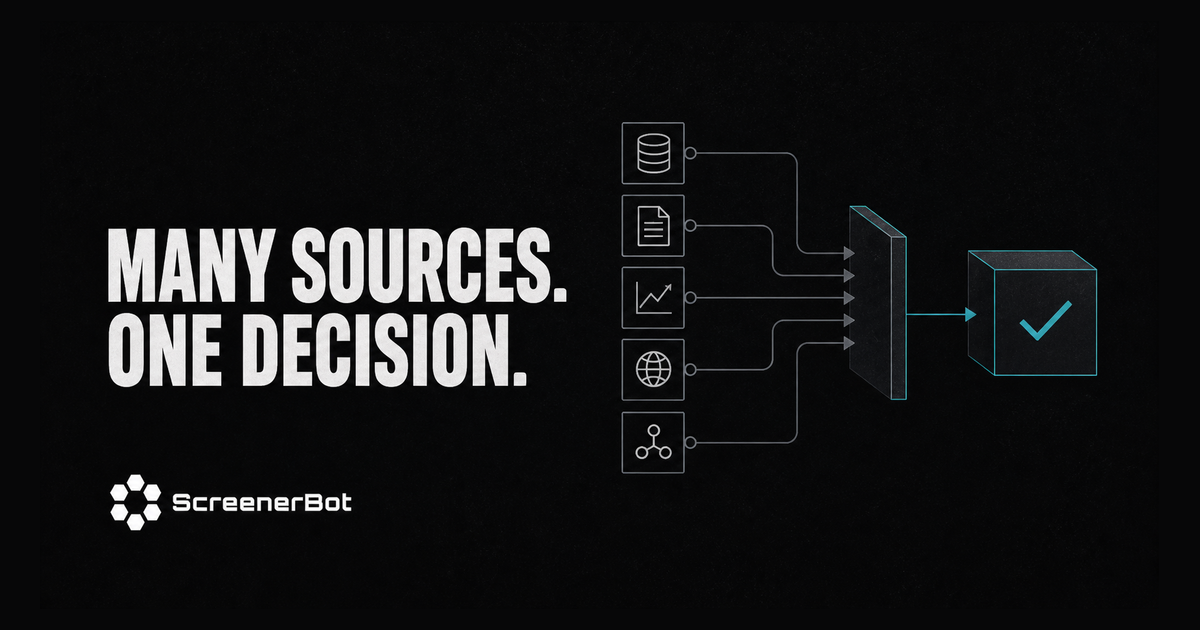
ScreenerBot's power comes from its ability to aggregate, validate, and act on data from multiple trusted sources across the Solana ecosystem. Unlike platforms that rely on a single data provider, we cross-reference information from specialized APIs to ensure accuracy, speed, and comprehensive market intelligence.
This blog post takes you under the hood to explore every data source that makes ScreenerBot tick.
🔗 Solana Blockchain (Direct RPC Access)
What it is: The Solana blockchain itself is our primary source of truth. We connect directly to Solana RPC nodes to read on-chain data-no middlemen, no delays.
What we use it for:
- Pool reserve data - Fetching liquidity pool account states for 12+ DEXs (Raydium, Orca, Meteora, Pumpfun, etc.)
- Real-time pricing - Calculating spot prices directly from pool reserves every 0.5 seconds
- Transaction monitoring - Streaming wallet transactions via WebSocket for instant P&L tracking
- Token account data - Reading token balances and metadata
- Transaction submission - Sending swaps, transfers, and other operations directly to the chain
Why it matters: Direct blockchain access gives us 3-100% more accurate pricing compared to aggregators that poll data every 30-60 seconds. For volatile or low-cap tokens, this accuracy difference can mean the difference between profit and loss.
RPC Provider: We use Helius RPC (premium endpoints) for high-performance, low-latency blockchain access. Helius provides globally distributed nodes with enhanced APIs, webhooks, and dedicated infrastructure optimized for Solana development.
Technical details:
- Update frequency: Pool prices every 0.5s, active positions every 5s
- Batch processing: Up to 50 accounts per RPC call
- Rate limiting: Built-in 20 calls/sec protection with 429 backoff
- Encoding: jsonParsed for automatic token account resolution
🔍 DexScreener
Website: dexscreener.com
What it is: DexScreener is a real-time DEX data aggregator supporting 80+ blockchain networks. It monitors smart contract interactions across decentralized exchanges and indexes trading data directly from blockchain logs.
What we use it for:
- Token discovery - Finding newly launched tokens across Solana DEXs
- Market data - Real-time prices, trading volumes, and liquidity pools
- Token profiles - Metadata like name, symbol, logo, and social links
- Trending analysis - Identifying tokens with recent volume spikes
- Search and filtering - Looking up specific token pairs and pool information
Key features:
- Covers Raydium, Orca, Meteora, Pumpfun, and all major Solana DEXs
- Real-time price updates aggregated from multiple exchanges
- Trading volume tracking (5m, 1h, 6h, 24h intervals)
- Market manipulation detection and warning systems
- TradingView charts integration for technical analysis
API endpoints we use (10 total):
- Token pairs lookup
- Batch token data retrieval
- Single pair information
- Token search
- Profiles and boosted tokens
- Orders and market data
Rate limits:
- Main endpoints: 300 requests/minute
- Secondary endpoints: 60 requests/minute
- Timeout: 10 seconds
Why it matters: DexScreener's comprehensive DEX coverage makes it our go-to source for market intelligence and token discovery. Its fast indexing catches new launches within seconds of pool creation.
🦎 GeckoTerminal
Website: geckoterminal.com
What it is: GeckoTerminal is a DeFi and DEX data aggregator from the team behind CoinGecko. It provides on-chain market data aggregated from various decentralized exchanges, with support for 90+ chains and 500+ DEXs.
What we use it for:
- Pool information - Detailed liquidity pool data and metrics
- Trending tokens - Top trending and recently updated tokens on Solana
- OHLCV data - Historical candlestick data for price analysis
- DEX listings - Complete list of supported DEXs on Solana
- Token metadata - Names, symbols, and contract addresses
- Trade history - Recent trades for specific pools
Key features:
- Centralized hub for liquidity pool insights across DEXs
- Easily readable format for token and pool data
- One-call access to all pools trading a specific token
- Comprehensive on-chain data compilation
- Real-time transaction and volume tracking
API endpoints we use (12 total):
- Token pools lookup
- Trending pools (1h, 6h, 24h)
- Top pools by volume
- Pool details and multi-pool queries
- OHLCV historical data
- DEX list and network information
- Recently updated tokens
- Trade data
Rate limits:
- 30 requests/minute (strict)
- Timeout: 10 seconds
- Network: Solana mainnet
Why it matters: GeckoTerminal provides a second layer of validation for our market data. By cross-referencing with DexScreener, we catch discrepancies and ensure data reliability.
🛡️ RugCheck
Website: rugcheck.xyz
What it is: RugCheck is Solana's leading token security analysis platform, founded in May 2023. It combines automated smart contract analysis with manual verification to identify potential scams and security risks.
What we use it for:
- Security scoring - Risk assessment scores for every token
- Authority checks - Verifying if mint/freeze authorities are renounced
- Holder analysis - Detecting concentrated ownership and whale wallets
- Contract scanning - Identifying malicious code, honeypots, and vulnerabilities
- Liquidity verification - Checking if liquidity is locked or burned
- Token stats - Aggregated security metrics and risk indicators
Key features:
- Processes thousands of tokens daily with automated scanning
- Manual code review by security experts for verification
- Partnership with Jupiter and FluxBeam for integrated security warnings
- Specialized analysis for Solana Token Extensions
- Database of known scam patterns and suspicious addresses
- Real-time monitoring of trading patterns for rug pull detection
What it checks:
- ✅ Mint authority status (must be null/renounced)
- ✅ Freeze authority status (must be null/renounced)
- ✅ Liquidity lock duration and burn status
- ✅ Holder distribution and concentration
- ✅ Trading volume patterns and manipulation signs
- ✅ Contract code for vulnerabilities and exploits
API endpoints we use (4 total):
- Token security report
- Summary report
- Stats and metrics
- Batch token reports
Rate limits:
- 60 requests/minute
- Timeout: 15 seconds (security analysis can be slow)
Why it matters: RugCheck is our first line of defense against scams. Every token must pass RugCheck's security criteria before ScreenerBot will even consider trading it. This automated pre-trade validation has saved users from countless rug pulls.
🪐 Jupiter
Website: jup.ag
What it is: Jupiter is Solana's largest DEX aggregator, handling over 50% of all Solana DEX trading volume. Launched in October 2021, it routes swaps across multiple DEXs to find the best execution price with minimal slippage.
What we use it for:
- Swap routing - Finding optimal multi-hop trading paths across Raydium, Orca, Meteora, and more
- Price quotes - Getting executable swap prices for token pairs
- Token discovery - Identifying recently launched, trending, and organically popular tokens
- SOL price feed - Real-time SOL/USD price from Jupiter's price API (updates every 30 seconds)
- Trade execution - Submitting optimized swap transactions with best rates
Key features:
- Smart routing that splits trades across multiple pools for better pricing
- Limit orders and Dollar Cost Averaging (DCA) support
- Automatic market addition (new tokens active for at least 14 days)
- Handles routes that would be impossible to discover manually
- Jupiter Pro with advanced charts and AlphaScan for token discovery
What makes it special:
- Routes analyze liquidity across dozens of DEXs simultaneously
- Calculates most efficient trading path in seconds
- Sometimes splits orders across multiple routes to reduce slippage
- Single-transaction execution from user's perspective
- No gas fees on many swaps (Jupiter covers network costs)
API endpoints we use (4 total):
- Recent tokens
- Top tokens by organic score
- Top traded tokens
- Trending tokens
- SOL/USD price feed
Rate limits:
- Timeout: 15 seconds
- Default limit: 100 tokens per request
Why it matters: Jupiter is our primary swap router. When ScreenerBot executes a trade, we query Jupiter alongside GMGN to find the best execution price. Jupiter's liquidity aggregation often finds better routes than direct pool swaps.
💧 GMGN
Website: gmgn.ai
What it is: GMGN is an advanced analytics and trading platform built specifically for Solana's meme token ecosystem. Founded in July 2023, it specializes in early token discovery and smart money tracking.
What we use it for:
- Alternative swap routing - Secondary routing option for low-cap and newly launched tokens
- Price quotes - Comparative quotes against Jupiter for best execution
- Smart money tracking - Insights into whale wallets and successful traders
- First buyer analysis - Tracking the first 70 buyers of new tokens for insider detection
- Security checks - Contract analysis, liquidity verification, and honeypot detection
Key features:
- Speed advantage: Price updates ~5 seconds faster than DexScreener
- Real-time token launch monitoring
- Automated security analysis (liquidity burned, contract renounced)
- Trading pattern recognition for scam detection
- Telegram bot integration for automated trading
What it checks:
- Contract security risks and potential honeypots
- Liquidity lock status and duration
- Ownership structure and permissions
- Historical trading patterns
- Holder distribution and whale concentration
API endpoint:
- Swap route quote API (GMGN router endpoint)
Rate limits:
- Timeout: 15 seconds (can be slower than Jupiter)
Why it matters: GMGN excels at finding routes for low-cap tokens that Jupiter might not cover well. For meme tokens and new launches, GMGN often provides better execution. ScreenerBot queries both Jupiter and GMGN, then automatically selects the router with the best price.
📊 CoinGecko
Website: coingecko.com
What it is: CoinGecko is one of the world's largest cryptocurrency data platforms, tracking over 3 million digital assets. Founded in 2014, it provides comprehensive market data, historical charts, and ecosystem analytics.
What we use it for:
- Token discovery - Extracting Solana token addresses from CoinGecko's massive database
- Cross-reference validation - Verifying token legitimacy and names
- Market context - Understanding global market trends and rankings
Key features:
- Coverage of 3M+ cryptocurrencies
- Prices available in 100+ fiat currencies
- Real-time market cap and ranking data
- Historical price charts and trading volume
- Exchange listings with trading pairs
- DeFi and NFT marketplace data
API endpoint we use:
/api/v3/coins/list?include_platform=true- Returns all coins with Solana platform addresses
Rate limits:
- Demo tier: 30 calls/minute (free with attribution)
- Timeout: 20 seconds (large datasets can be slow)
Why it matters: CoinGecko's extensive token database helps us discover established tokens that might not be showing up on DEX-focused aggregators. It's particularly useful for identifying legitimate projects with multi-chain presence.
📈 DefiLlama
Website: defillama.com
What it is: DefiLlama is the largest TVL (Total Value Locked) aggregator for DeFi protocols. Launched in 2020, it tracks thousands of protocols across hundreds of blockchains with transparent, open-source methodology.
What we use it for:
- Protocol analytics - Tracking DeFi protocols on Solana
- TVL data - Monitoring total value locked across protocols
- Token price data - Alternative price source for Solana tokens
- Market context - Understanding DeFi adoption and trends
Key features:
- Tracks 6,000+ DeFi protocols
- TVL, yields, stablecoin data, and protocol rankings
- Real-time analytics across 500+ chains
- Transparent methodology (no ads, no sponsored content)
- Open-source platform
- Historical TVL and protocol breakdowns by token/chain
API endpoints we use (2 total):
/protocols- List all DeFi protocols/prices/current/solana:{mint}- Get current token price
Rate limits:
- Timeout: 25 seconds (protocols endpoint can be slow with 6k+ protocols)
Why it matters: DefiLlama provides macro-level DeFi intelligence that helps us understand protocol health and ecosystem trends. It's also a fallback price source when other APIs are unavailable.
🔗 Helius RPC
Website: helius.dev
What it is: Helius is Solana's leading RPC and API platform, providing the infrastructure that connects ScreenerBot to the Solana blockchain. It offers enhanced APIs, webhooks, and globally distributed nodes optimized for performance.
What we use it for:
- Blockchain access - All RPC calls to read and write Solana data
- Transaction submission - Sending swaps and transfers to the network
- Account data fetching - Reading pool reserves, token balances, and metadata
- WebSocket streaming - Real-time transaction monitoring
- Parsed data - Automatic token account resolution with jsonParsed encoding
Key features:
- Staked RPC: Routes connections through stake-weighted nodes for better confirmation rates
- Enhanced APIs: Parsed transaction data, NFT metadata, token holdings out-of-the-box
- Webhooks: Real-time event notifications
- LaserStream: High-performance gRPC streaming service
- Global nodes: Infrastructure in New York, Singapore, Tokyo, Frankfurt for low latency
- Security: IP and domain lockdown, RPC proxy support
Why it matters: Premium RPC infrastructure is critical for trading performance. Helius's low latency, high reliability, and advanced features ensure ScreenerBot can execute trades in milliseconds and stream real-time data without interruption.
Technical details:
- Rate limiting: 20 calls/sec with automatic 429 backoff
- Round-robin URL rotation for load balancing
- Support for batch operations (50 accounts per call)
- jsonParsed encoding for v0 transaction support
- Premium-only mode available for maximum reliability
🎯 How It All Works Together
ScreenerBot's multi-source architecture creates a robust, fast, and accurate trading system:
1. Token Discovery
- DexScreener → New launches and trending tokens
- Jupiter → Recently added and top organic tokens
- GeckoTerminal → Trending pools and updated tokens
- CoinGecko → Established tokens with verified metadata
2. Security Validation
- RugCheck → Automated security analysis (authorities, holder distribution, contract code)
- GMGN → Smart money tracking and honeypot detection
- On-chain → Direct verification of token metadata and supply
3. Price Calculation
- Solana RPC → Direct pool reserve data (primary source, updated every 0.5s)
- DexScreener → Cross-reference validation
- GeckoTerminal → Secondary validation
- Jupiter → SOL/USD conversion rate
4. Trade Execution
- Jupiter → Quote for best multi-hop routing
- GMGN → Quote for alternative routing (especially low-cap tokens)
- Compare quotes → Automatically select best execution price
- Solana RPC → Submit transaction via Helius
5. Monitoring
- WebSocket (Helius) → Real-time transaction streaming
- Solana RPC → Position price updates every 5 seconds
- DeFiLlama → Protocol TVL and ecosystem health
⚡ The Speed Advantage
Compared to single-source platforms:
| Operation | ScreenerBot | Traditional Aggregator |
|---|---|---|
| Price calculation | 5-50ms (direct pool read) | 500-2000ms (API polling) |
| Security check | <100ms (RugCheck + on-chain) | Manual research required |
| Best route finding | <500ms (Jupiter + GMGN parallel) | Single router only |
| Trade execution | <1s (signal to chain) | 500-1500ms (API delays) |
Multi-source validation catches:
- Price discrepancies (3-100% differences in volatile markets)
- Stale data from slow-updating APIs
- Missing security risks (each source checks different factors)
- Failed RPC providers (automatic fallback to alternatives)
🛡️ Why Multi-Source Matters
Single points of failure are eliminated:
- If DexScreener is down → GeckoTerminal + direct blockchain
- If Jupiter can't route → GMGN alternative
- If one RPC endpoint fails → Automatic rotation to backup
- If RugCheck is slow → Cached security scores
Cross-validation prevents errors:
- Price A from DexScreener, Price B from GeckoTerminal, Price C from chain
- If prices differ by >5% → Flag for investigation
- If security scores conflict → Choose most conservative result
- If token metadata mismatches → Verify on-chain
Comprehensive coverage:
- DexScreener focuses on DEX data
- GeckoTerminal covers liquidity pools
- RugCheck specializes in security
- Jupiter excels at routing
- GMGN tracks smart money
- CoinGecko provides global context
- DefiLlama monitors protocols
🔮 The Future
As Solana's ecosystem evolves, ScreenerBot's data infrastructure will expand to include:
- More DEX integrations - Coverage for emerging AMMs
- Enhanced security sources - Additional risk analysis providers
- Cross-chain data - Multi-chain token tracking
- Social sentiment - Twitter/Discord signals
- On-chain analytics - Advanced holder behavior analysis
💡 Takeaway
ScreenerBot doesn't rely on a single data source-it orchestrates eight specialized APIs to create a comprehensive view of the Solana DeFi landscape. By combining direct blockchain access, market data aggregators, security analysis, and smart routing, we deliver the accuracy, speed, and safety that serious traders demand.
Every data source has a purpose. Every endpoint is optimized. Every millisecond matters.
That's what it takes to build a professional trading bot.
Ready to experience the power of multi-source intelligence? Download ScreenerBot and start trading.